Showing posts with label outdoors. Show all posts

Thursday, July 28, 2011

Milk Carton Bird Feeders

Milk Carton Bird Feeder
This project is so easy! We snuck out of the house early yesterday morning to wander around the gardens at Wing Haven Garden and participate in their weekly "In the garden" time set aside specifically for children.

We would never turn down an opportunity to putter about in a garden, say hi to a bunny and some chickens, drink lemonade and do a craft. The most beautiful part about all of this? Mama just had to sit back and admire the flowers! What a perfect morning.

Q with his creation
This week, the children's craft was making milk carton bird feeders. The supplies were easy ... a milk carton, some stickers and markers, a skein of yarn, and some bird seed.

Miss Shaelynn cut the milk cartons for us ahead of time. About one inch from the bottom use sharp scissors to cut about a six inch opening that takes up 2 sides - leaving the handle intact. After the hole has been cut the kids can decorate the bird feeder with stickers or color with markers.

Once the decorating is done, tie a piece of double strength string around the handle so that the bird feeder can be hung on a tree or a hook. Our yard has no shortage of bird feeders, but who couldn't use one or two more? The birds will thank you! Have fun!

Entrance to the Children's Garden


If you are in the Charlotte area, be sure to check out the beautiful Wing Haven Gardens! They have wonderful programs for children, gardening classes for adults and a fabulous plant sale every year.

Thursday, July 14, 2011

Pick Your Own

Camp Brighton is still in full swing although we have temporarily relocated up north for a visit with the all-important grandparents. Unfortunately, my camera and a good internet connection were left behind in Charlotte. Alas, we are making do...

One of our summer traditions has always been blueberry picking. We are lucky enough to have a wonderful farm just a few minutes away from my parents' house. However, no matter what state we have lived in - Ohio, Massachusetts, and now, North Carolina, I have enjoyed searching out "pick-your-own" opportunities because they are so much fun and also a great way to support local farms and businesses.

It isn't too difficult to find out if there are any local fruits or veggies just waiting to be picked by you and your family. Most state agriculture boards offer a list of pick your own farms. There is also a great website - aptly named pickyourown.org - that allows you to search by state to find farms near you. In North Carolina, we are lucky to have a vibrant community that strives to support local agriculture and a local author, Diane Daniel, recently released a new book - Farm Fresh North Carolina - an excellent guidebook to exploring food and farms all over the state.

Off to a good start!
Enjoying the view from my back ...


Blueberry picking is an activity that can be enjoyed by children of all ages. Because the blueberry bushes are generally small - most of the bushes at the farm we were picking at were all shorter than an average adult - the berries are very low to the ground and can be easily picked by your littlest walker. Buckets were provided upon our arrival and we were directed to a small grove of bushes just bursting with blueberries.

Our tired crew is ready to go home!
The children were issued 2 simple instructions, "Only pick the blue ones and don't pick up the ones on the ground." The children scattered, eager to get picking. My friend and I were left alone to leisurely chit chat and pick our own buckets of berries.  This activity is such a great way to get your kids outside, enjoying the fresh air, and really connecting their food to the actual source. Blueberries already enclosed in a plastic clamshell will never look the same again!

When you look for a local farm, you will want to be aware of hours and picking conditions. We arrived at the farm rather early - we wanted to make sure the farm didn't get "picked out" and we also didn't want the kids to get overheated as the day wore on. Our farm had picking hours from 7 to 12 so be sure to call ahead to confirm that the farm is open and ready for your gang.

Of course, one of the best parts of a pick-your-own farm experience is the built-in snack factor but another great aspect is the ability to bring home your loot and continue to eat it and cook with it. The very next day we made a blueberry quick bread and a blueberry streusel cake. Delicious!! If you find that you have picked too many blueberries, you can always freeze them. Don't wash them first. I like to measure out 2 cups of blueberries at a time and place them in freezer bags. Other techniques suggest laying them out on a cookie sheet and freezing them before putting them into freezer bags and storing in the freezer. Blueberries keep very well in the freezer - we have easily kept them past six months in a cold part of the freezer with no issues. Find yourself a farm and get picking!


Additional Resources:

Tuesday, July 5, 2011

Flower Prints

The basics ...
My girls and I went to the Davidson Farmers Market a few weeks ago and they were doing a great craft - flower prints. If you have kids with short-attention spans or children who like to bang things, this is the project for you.

You will need:

Assorted colorful flowers
Paper (paper with a little texture works well)
Wax paper
Rubber mallet

How-to: 

"I found blue!"
This activity started with a flower hunt - my kids were told to find one flower per color so as not to decimate my mother's lovely gardens. The mission was successful; as they ran around the yard, I could hear them calling out, "I found yellow!" and "Does anyone have blue?" For the most part, they all stuck to the "one flower per color" rule.

After collecting the flowers, the real fun began ... the banging. Using somewhat rough paper, the kids arranged the flowers (or just the petals) face down on the paper placed on a hard surface. (We used scraps of wooden boards.) I tore off a piece of wax paper roughly the size of the paper and placed it over the flower - one flower at a time works best and then they can rearrange the flowers or petals as they wish. Using a rubber mallet, the kids banged away on their little flower, trying to transfer some color and even a little bit of the petal imprint, to the paper.

Watch your fingers!
Helpful hints ... After much experimenting, we discovered that "little bangs" were better at transferring color from the petal to the paper. "Big bangs" with the rubber mallet were not very successful. We also tried to eliminate the wax paper and just hit the flower but, for the most part, that technique did not work well at all. The girls also tried to get the flowers a little bit wet before they banged them, a little too much water quickly made the paper a soggy mess so we opted not to dampen the flowers at all - being that they were freshly picked, they were a little damp to begin with.  Also, although a rubber mallet is not too heavy, it is probably a good idea to remind your little people not to put their fingers in the way!

Try different flowers, different colors, different papers. Let the children "experiment" to see what works the best! Have fun!

Wednesday, June 29, 2011

Recycled Nature Buckets

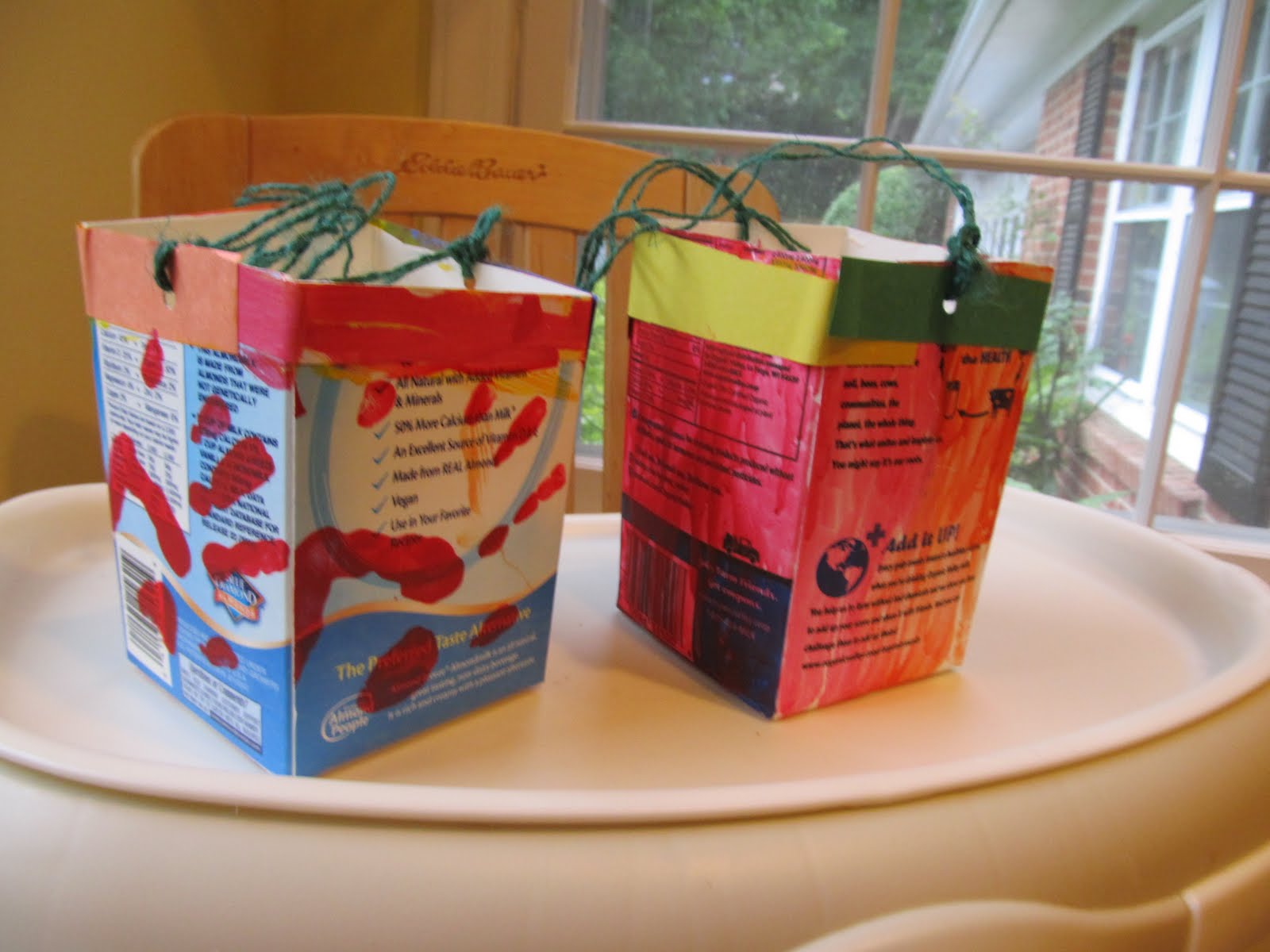
2 of the final products
We are always going on nature walks - sometimes down the street or around the park and sometimes just in our own backyard. Having the children make their own nature buckets alleviates the problem of "Mom, mom, can you carry this bug home for me?"

Gather together... 

Empty milk cartons, rinsed and dried
Paint, glue, paper, stickers, paintbrushes
Hole punch
Twine or string

How-to... 


Decorating his nature bucket
For this project, I set aside three empty milk cartons - in this house, that took just a couple of days! Rinse out the cartons and let them dry. Open the tops of the cartons like you would open a small milk at school and, using a scissors, make a cut down the side to give you access to cut evenly around the top of your milk carton to make a nice-sized bucket. You can make these buckets small for little people, or taller for the big kids.

Since every project in our house seems to involve paint, I set out some different colors of paint and strips of paper so that they could decorate their nature buckets. Stickers or markers would also work well.

Someone always has to paint herself...
Colored glue trick: I like to use regular Elmer's school glue but I tint it with one of the paint colors. For this project, we tinted the white glue with yellow paint. All you have to do is squeeze some white glue into one of your egg carton spaces and then add any color. Gently mix it together with your paintbrush and you have colored glue! We try to keep a designated paint brush the GLUE BRUSH and clean it with soapy water after our project is finished. I have rarely seen anything good come out of having small children squirt glue out of an unwieldy bottle. This approach seems to make our projects go much more smoothly when glue is involved!

To finish... 

A hole punch and twine
Once your bucket is decorated and has dried, use a hole punch to punch a hole in two sides. Cut a piece of twine or string double the length of the handle that you would like to have and loop it through the holes. Double knot the double length string or twine on the inside of the nature bucket and presto! your project is complete!

Happy nature hunting! These buckets can be used to collect bugs or leaves or mushrooms or just about anything. Enjoy! 

Tuesday, June 21, 2011

Leaf Rubbings

Making a leaf print, or leaf rubbing, is an easy and fun activity for kids of all ages that can be done just about any time of year. All you need are some interesting leaves, some pieces of paper, and a few crayons with no wrappers. We always seem to have an assortment of broken crayons - coloring can be such an intense activity over here - that we use those broken crayons for the leaf rubbings.

Place your leaf under a piece of paper - any kind of paper will work, we used white paper and different colored crayons. Take your paperless crayon and rub back and forth over the leaf using the side of the crayon. Your kids will be excited to watch the details of the leaf emerge! My kids like to experiment with the leaf upside down and right side up - you will get a good image either way but you might get a little bit more detail with the leaf upside down.

My daughter wanted to cut out her leaves and glue them into her nature journal. My son preferred to make a bunch of leaf rubbings on one page to create a sort of leaf collage. The possibilities are endless. For older children, you can find a nature guide that would help them identify the types of leaves they find so they can label their rubbings.

For more information on identifying leaves, click on the links below: 

About.com Identify and Name 100 Common Trees
Ohio Public Library Information on Leaf Identification

Monday, June 20, 2011

Nature Journals

My kitchen compadre, the cicada
We looove nature over here. At the moment, there is a GIANT cicada residing right beside the cooktop. Sometimes, when the house gets a little bit too quiet, we chat a little. If you live in the south, you know that we grow bugs big down here. I was slightly concerned when I heard that news upon my arrival to Charlotte, my kids, however, heard that and were elated. When I see pest exterminator trucks driving around my neighborhood, I am often tempted to offer the services of my children... you wouldn't even need to pay them - just promise they can keep whatever they catch.

Needless to say, when the campers think that there is absolutely nothing to do, I can always resort to a "bug hunt." And, after a bug hunt, what better way to chill out and have some quiet time than to "write" about the bug hunt in your nature journal. When I am not head counselor at Camp Brighton, I am a teacher of other people's children so I have to throw in my two cents about having children write every day. Every day. Spelling and grammar are much less important than developing the habit of sitting down and putting colored pencil to paper. It's never too early to start developing these good habits and a nature journal alleviates the "what do I write about?" anxiety that many children face.

In our nature journals, most of the page is often taken up by a large illustration. Sometimes the description is one word (or no words at all for my 3 year old). For my older children, now six, I will usually give them no direction - I let them decide what and how much they would like to write. If they are stuck, I might suggest a topic or a specific amount of sentences that I would like to see, or I might tell them I want to see six description words. I might also give them a prompt - maybe the first part of a sentence that they have to finish.

Fun Activity: Making the Nature Journals

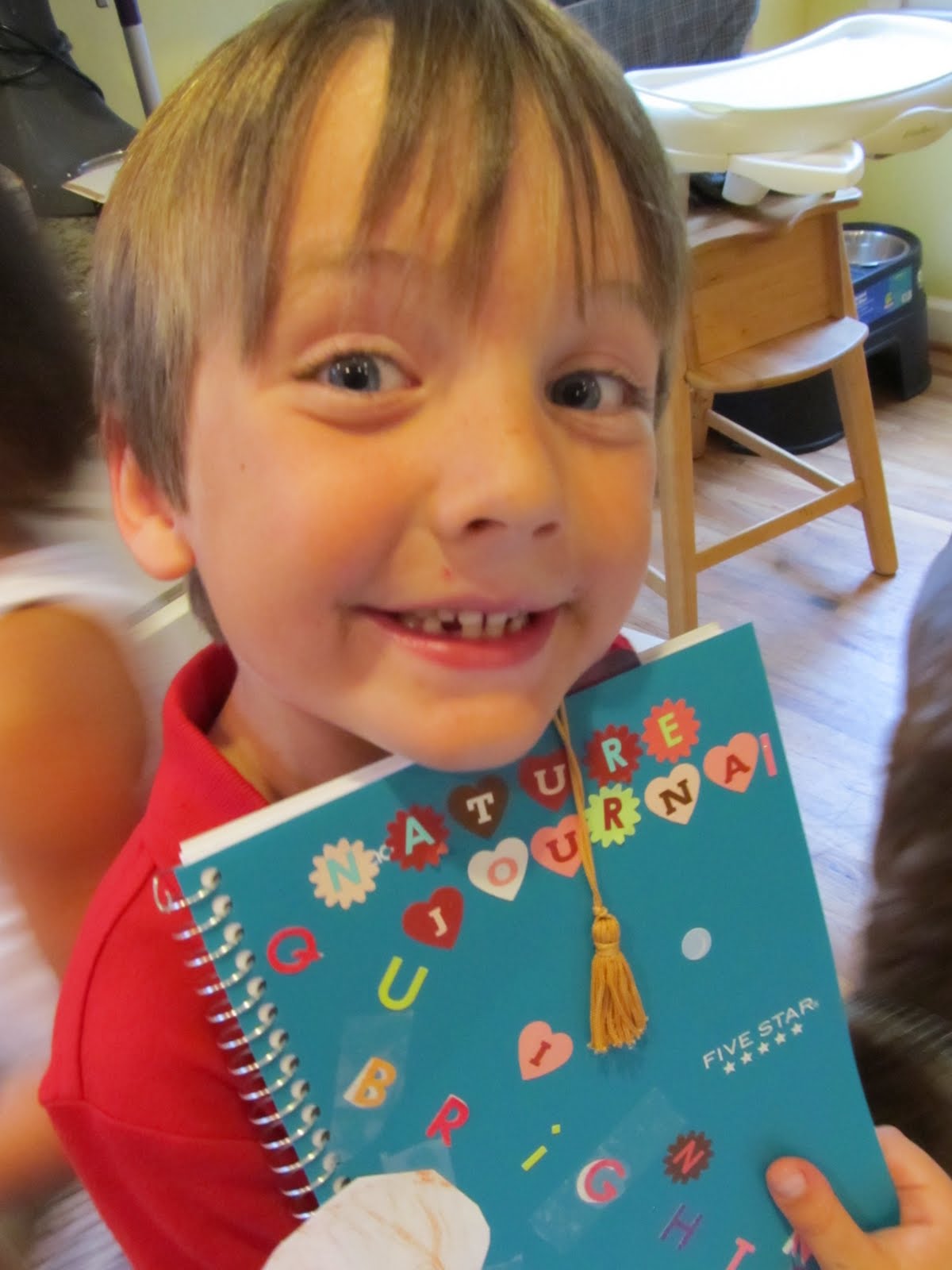
Making the nature journals is a project in and of itself. Let the child choose a notebook or use one you can find around the house - it can have blank pages or lines. Mead makes an excellent composition notebook for little writers (grades K - 2) that has half a page of lines and half the page blank for illustrations. You can order them online or find some at Target or other office supply stores. Get some nature stickers and letter stickers and decorate the cover. My older children chose small notebooks that had lines and a pocket inside to store "keepsakes" - ticket stubs, photos, etc. We found inexpensive notebooks at Target for about $2 and stickers for $.99. These journals usually accompany us on all car trips - even if we are just going down the street to the school playground or to Freedom Park. You never know what you might find!

For more information on the importance of the development of a relationship between children and nature, read this article from 2004 written by Randy White. (Click here for the pdf)


I also recommend that you read Last Child in the Woods by Richard Louv. 

Check out this website for prompts and other ideas for nature journals: Keep a Nature Journal

Thursday, June 16, 2011

Mushroom Spore Prints

It's been a little rainy around here lately in the evenings. Absolutely not complaining - the more little rain storms we get, the less watering of the plants and veggies do I have to do. Along with the benefit of watering my gardens, the rain also provides some nice moisture perfect for the growth of mushrooms. Today we went on a mushroom hunt with the plan to take some mushroom spore prints. I remember doing this as a child - my parents never throw anything away so if you visit my childhood home, you will probably see at least one or two really great specimens lining the plate rail in my parents' living room. I am not sure that I can promise my children the same, but they seemed to love this project just as much as I did.

What the heck is a mushroom spore print?

A mushroom spore print is the imprint of the spores from the underside of a mushroom cap on a piece of paper. Different mushrooms leave different spore prints so, if you are into identifying mushrooms (confession: me, me!), a mushroom spore print will aid in proper identification.

How To:

For this project, all you need are some newly grown mushrooms - if they are too old, they will have already dropped their spores outside - and some colored construction paper.

Different mushrooms have different colored spores. Some spores are white or gray, others could be black or red. Let the kids choose different colors of paper to make this even more experimental.

All you need to do for this experiment is to carefully remove the stem from the mushroom and place the mushroom on a piece of paper. If the mushrooms are bigger, the kids can probably remove the stems themselves. Because these mushrooms were so tiny, I snipped off the stems with my kitchen shears. Cover the mushroom with a water glass so little fingers don't try to check the progress! Let the mushroom sit for a few hours - we gathered our mushrooms before swim team practice and let them sit for about 5 or 6 hours before we came back to check on them.

When the time is up, lift your mushroom and look for the spore imprint. The kids were thrilled that their little mushrooms left such vivid spore prints! Ours were a lovely rust-colored orange! We can't wait to see what our next mushroom discovery looks like...

For more information about mushrooms: 

The American Mushroom Institute put out a mushroom workbook for kids

The Cap Crew - a website about mushrooms from Canada

Information about identifying different types of mushrooms

Monday, June 13, 2011

Plant a Pizza Garden

Who says a pizza has to be round?
Do your kids love pizza? My kids love pizza so much that for their 6th birthday we piled into the fabulous Fuel Pizza (a delicious local pizza place) and made pizzas with a tawdry assortment of kindergarten classmates. It was a lot of fun and quite a treat for them to see a "real" pizza kitchen - i.e. not Mom's. Since my daughter has celiac disease (no gluten!) we usually make our own pizza. It's really so easy (click here just to see how easy it is...) and you can top it with just about any fresh veggies you have on hand. Making your own pizza tastes even better when you can put your own home-grown toppings on it!

Container Gardening

This summer we have planted three large raised bed gardens(one for the boys, one for the girls, and the biggest one for mom) and a few container gardens. Raised bed gardens are very easy to maintain and can be tended by adults and children, however, nothing beats the ease of a container garden. Our largest container garden is called "The Pizza Garden" because it contains many essential pizza ingredients. I have picked up large pots for container gardens at quite an assortment of stores - Marshall's, Big Lots, end-of-season sales at local nurseries and garden shops... you don't have to pay a lot of money to find a suitable container. Be creative - do you have something non-traditional you could use? A small boat? A baby pool? A small tub?  
At the "boys' garden" ...

Whether you are new to gardening or are a seasoned pro, container gardens are so easy to plant and very easy to maintain. If you have enough room, each child could even have their own. For our "pizza garden" we planted a cherry tomato plant in the center, a small pepper plant off to one side, and fresh basil, thyme, and oregano, all around the edges. This is the second year that we have grown a pizza garden and, although very few cherry tomatoes actually make it inside because they are usually eaten by the no-wage pickers, we always can put the peppers and herbs to great use.

What you will need to plant your pizza garden: 

1 large pot
Soil suitable for container gardens
1 cherry tomato plant
1 small pepper plant
Assorted herb plants ... basil, oregano, and thyme

In less than an hour, you can have your pot filled with dirt and plants, watered and ready to grow! Have fun! It's definitely not too late to plant some veggies. Go out and give it a try. If you are even more adventurous and are interested in raised bed gardening, check out the Gardening Gals website - a Charlotte, mom-owned business - if you are here in Charlotte, they will install your raised bed garden in no time at all so you can get right to the planting!

For more information on container gardening, check out the links below...

Gardening With Kids: Information on Container Gardens
Charlotte Parent Magazine: Planting a Pizza Garden
Growing Ideas Classroom Projects: Container Gardens With Kids

Saturday, June 11, 2011

Day One ... Let's Launch Some Rockets!

The last bus stop of the school year...
Summer vacation began yesterday afternoon if you are a public school student in Charlotte, North Carolina and the hot topic of conversation since about February has been summer camp. As in, where are you sending your child to camp?

Camp can be a lot of fun. It can also be a lot of money and a logistical nightmare when you have multiple children. As I packed my last set of school lunches yesterday, checked bookbags, looked for shoes (are they wearing any?), and lightly nudged my children out the door of the minivan as we rolled through carpool drop-off, I cannot say that I was sad to say good-bye to this early (very early) morning ritual for the next 75 days. And, to answer the question posed earlier, where are my children going to summer camp, my children will be attending Camp Brighton.

Camp Brighton has all the amenities of a traditional day camp - arts and crafts, organized activities, a little water play, and snack time. Camp Brighton does not require a lot of money or lunches packed the night before. Camp Brighton does not even require shoes.

Day One ... Rocket Launching

Day one of Camp Brighton found us - all 6 of us - attending a previously scheduled activity (we love those kind!) - rocket launching! Who doesn't love a good rocket launch on a gorgeous June afternoon? This activity is recommended for children ages 10 and up with hands-on adult participation. That being said, the children that were involved in this launch activity were all under 10... truth be told they were more spectators and in charge of the countdown. Even so, this activity provided over 90 minutes of fun in the middle of a scorching hot afternoon. A few smaller children were bothered by the noise and a few older children were not happy to see their rockets land in treetops but, for the most part, this activity was a blast...

Where to begin?

There are a few options for rocket launching - some more basic than others. Since this was the first time my 6 year olds have been a part of any launching parties, my husband took the easier rocket route. He headed over to Hobby Lobby and looked for RTF (ready to fly) rockets made by Estes. Estes has a great website with a wide variety of rockets (click here to access their site.) You can purchase RTF rockets, easy to assemble rockets, or different kits that are geared for much older children or adults. The simplest rocket can be purchased for less than $10 but it is so small that it doesn't come with a recovery parachute. For a few dollars more, you can get a rocket that can go pretty high in the air and gradually descend once its attached parachute opens.

Can you see the rocket?
In addition to a rocket, you will need a launcher and an engine. If this is your first rocket launch, you can purchase a kit that comes with a rocket and launcher for less than $30. You can purchase additional packages of engines and igniters to do more and more launches. Read the engine size and your rocket size carefully to make sure they match up - bigger is not always better. Our group's first rocket went so high, got picked up by a little gust of wind, and came down across a busy road. Oops!

We all met up at the field of a local school for the launch - do your best to find some open air and a dearth of trees. Although it was exciting to watch the rockets lift off quickly in a puff of smoke, the children might have had even more fun chasing the rockets as they swirled back to earth attached to their parachutes. This is certainly a great activity that can be enjoyed with one child or a large group. I will certainly chalk up Day 1 at Camp Brighton as a complete success.

Please post any additional tips or suggestions in the comments section if you have done this with your kids!  
The chase was sometimes the best part.

More rocket launching resources ...

If you are interested in more ideas for testing out Newton's Third Law of Motion through rocket launches, check out the links below:

Build a Bubble-Powered Rocket! (NASA)   
Wired-Science: Geek-Dad Soda Bottle Rocket